Walk through the city of Sydney, and you’ll find plenty of statues of governors, explorers, royals, politicians, poets, and saints, many so familiar they blend into the background.
Each one was put there for a reason, and the stories behind them say a lot about who the city chose to honour and how it saw itself at the time. This list covers 17 historic statues, from Queen Victoria at the QVB to William Bligh in The Rocks.
Most are close enough together to be linked up on a single walk, with plenty of stops around Hyde Park, Macquarie Street, and The Domain. For each statue below, you’ll find out who the person was and what makes the monument worth a closer look.
Use this interactive map as a handy guide when exploring them yourself.
1. Queen Victoria (QVB)
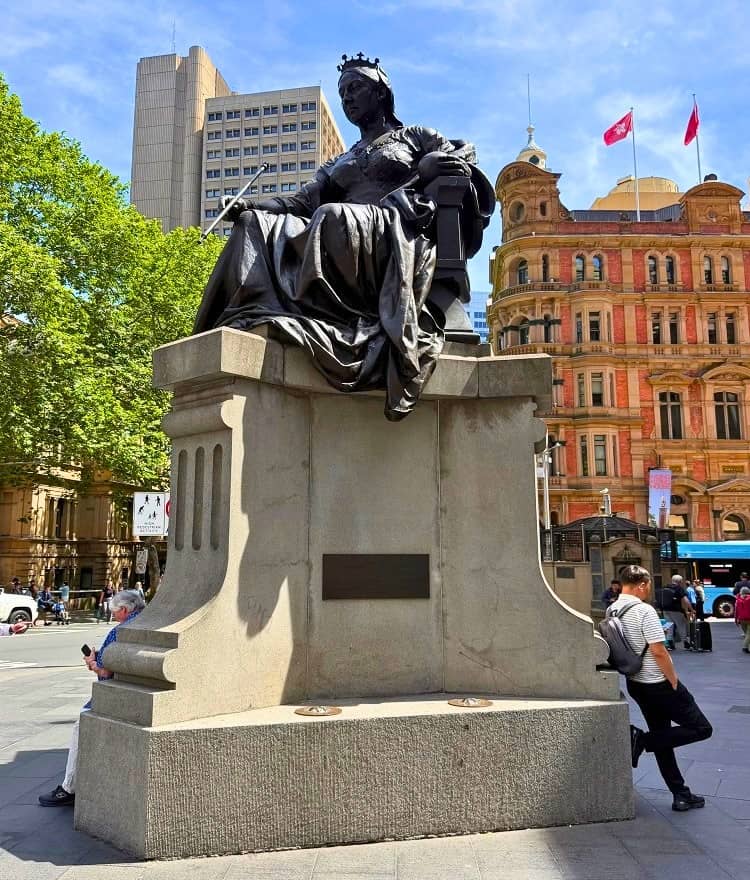
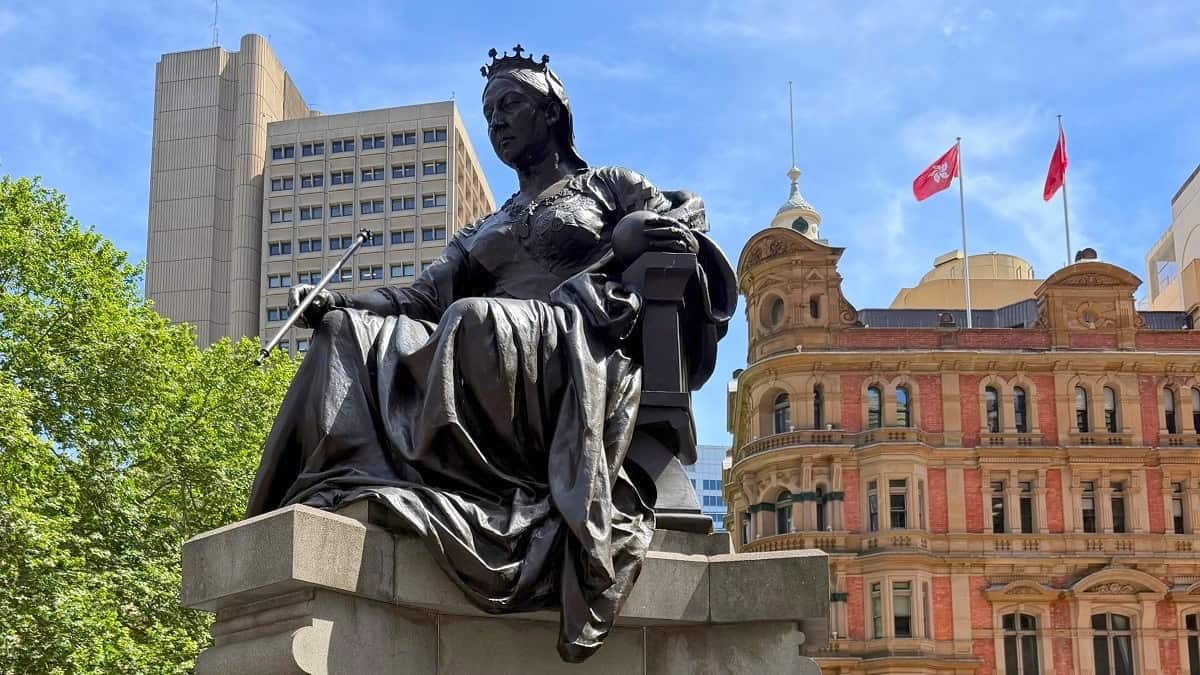
This bronze statue of Queen Victoria stands on the corner of George and Druitt streets, outside the Queen Victoria Building, and it has come a long way to get here.
Sculpted by Dubliner John Hughes, it was unveiled in 1908 in front of Leinster House in Dublin. After Irish independence, Leinster House became the seat of the Irish parliament, and the statue was later removed and put into storage. In the 1980s, the QVB’s project manager searched several countries for a statue of the Queen, and Ireland was the only one willing to part with one.
It was offered to Sydney as a gesture of goodwill, on a “loan until recalled” basis, and unveiled on 20 December 1987.
| Queen Victoria (QVB) | |
|---|---|
| Sculptor: | John Hughes |
| Year unveiled: | 1987 |
| Location: | Queen Victoria Building (QVB) |
2. Captain Cook
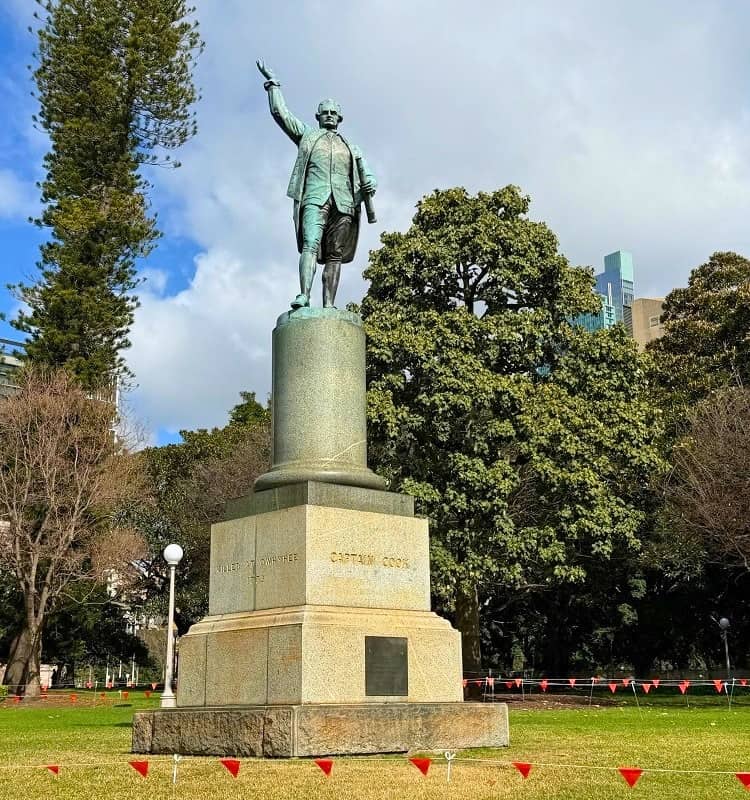
Standing in Hyde Park South, near Elizabeth Street, this larger-than-life bronze statue of Captain James Cook was unveiled on 25 February 1879.
English sculptor Thomas Woolner shows Cook holding a telescope in his left hand, with his right arm extended skyward. The foundation stone was laid in 1869, but the pedestal sat empty for nine years while the funds ran short, until the colonial government stepped in.
The unveiling day was declared a public holiday, and an estimated 60,000 people turned out to watch. The Moruya granite plinth carries the line “Discovered this territory, 1770”, which has long drawn criticism, as Cook’s party landed at Botany Bay and never entered Sydney Harbour.
| Captain Cook | |
|---|---|
| Sculptor: | Thomas Woolner |
| Year unveiled: | 1879 |
| Location: | Hyde Park |
3. Saint Mary of the Cross MacKillop
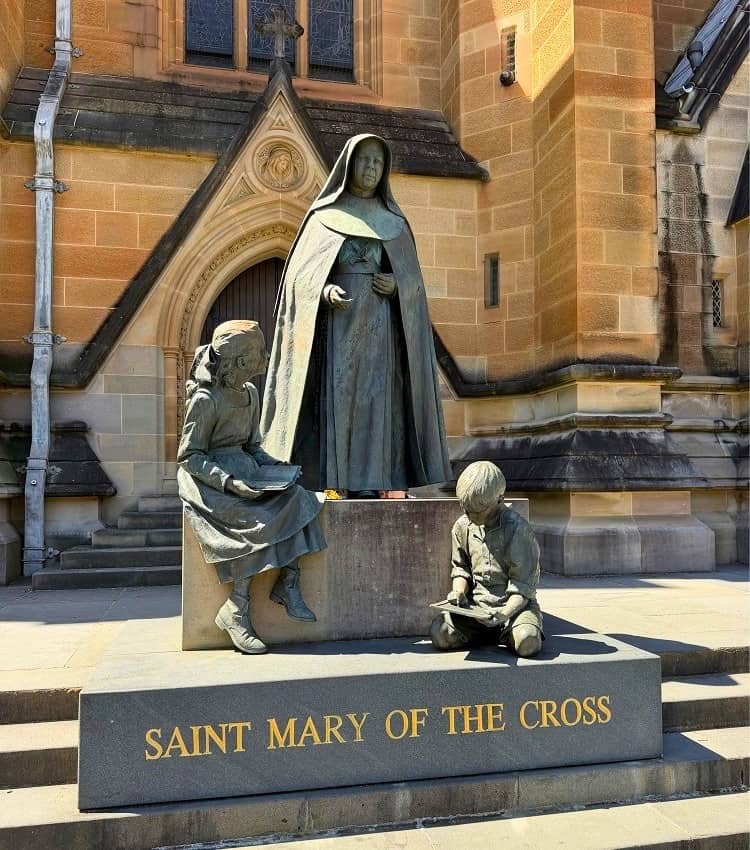
This statue at St Mary’s Cathedral, on College Street, honours Mary MacKillop, Australia’s first saint.
Sculpted by Louis Laumen, it was unveiled on 10 October 2010 by Cardinal George Pell, then Archbishop of Sydney, a week before her canonisation in Rome on 17 October. MacKillop was a Catholic nun who, together with Father Julian Tenison Woods, founded the Sisters of St Joseph of the Sacred Heart.
She died in 1909, and since her canonisation she has been known as Saint Mary of the Cross, which is the name on the statue’s front inscription.
| Saint Mary of the Cross MacKillop | |
|---|---|
| Sculptor: | Louis Laumen |
| Year unveiled: | 2010 |
| Location: | St Mary’s Cathedral |
4. Major General Lachlan Macquarie
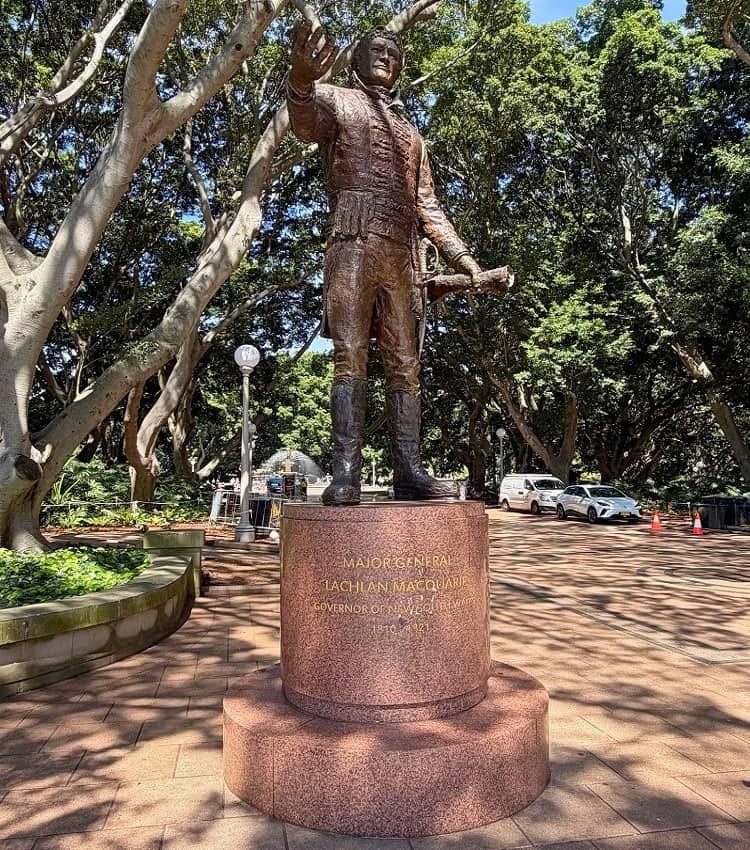
On the Macquarie Street side of Hyde Park North stands a statue of Lachlan Macquarie, who served as Governor of New South Wales from 1810 to 1821.
Sculpted by Terrance Plowright, it was commissioned by the NSW Government and unveiled on 31 January 2013 by the then Governor, Professor Marie Bashir.
Macquarie oversaw a period of major growth in the colony, and some historians credit him with helping to shift New South Wales from a penal colony towards a free settlement. However, his treatment of Aboriginal people remains controversial.
| Major General Lachlan Macquarie | |
|---|---|
| Sculptor: | Terrance Plowright |
| Year unveiled: | 2013 |
| Location: | Hyde Park (Macquarie Street) |
5. Queen Victoria
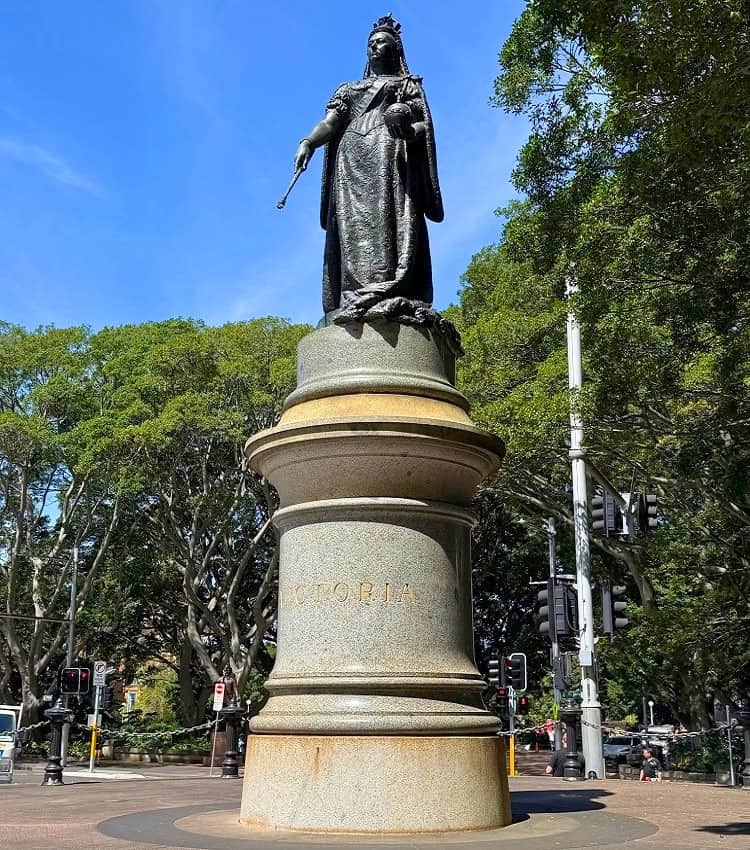
This statue of Queen Victoria stands in Queens Square, just north of Hyde Park.
It was unveiled in 1888 as part of Australia’s centenary celebrations, about a century before the statue outside the Queen Victoria Building was unveiled in 1987. The square itself was named in her honour after she came to the throne in 1837.
Across Macquarie Street, a statue of her husband, Prince Albert, faces it.
| Queen Victoria | |
|---|---|
| Sculptor: | Sir Joseph Edgar Boehm |
| Year unveiled: | 1888 |
| Location: | Queens Square |
6. Prince Albert
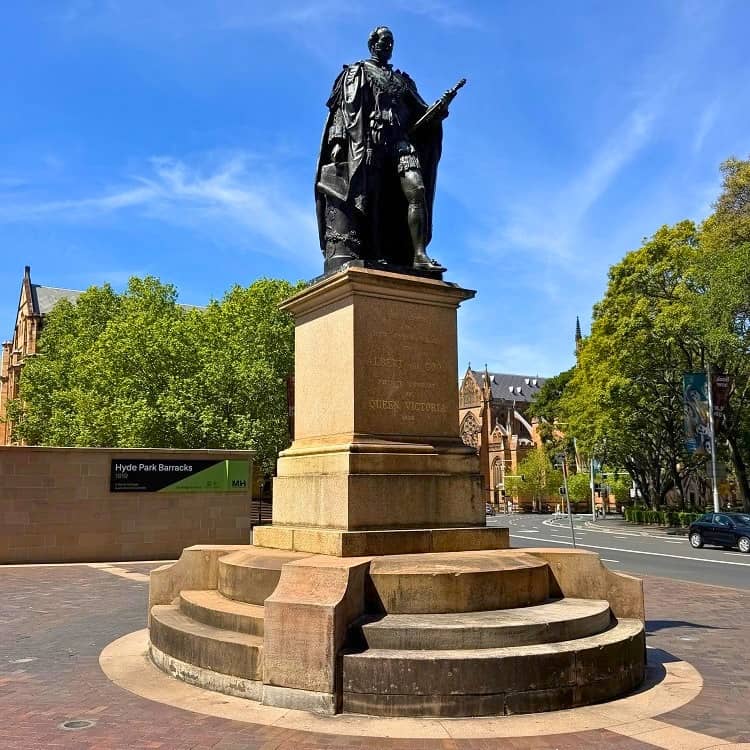
This bronze statue of Prince Albert stands in Barracks Square on Macquarie Street, in front of Hyde Park Barracks. Albert was Queen Victoria’s husband, and he died in 1861 at the age of 42.
The people of New South Wales paid for the statue through a public subscription, and it was unveiled on 23 April 1866 before a large crowd. Designed by English sculptor William Theed the Younger, it shows Albert in the robes of the Order of the Garter, holding a sceptre in his left hand and a scroll in his right.
It originally stood at the northern entrance to Hyde Park, was moved to the Royal Botanic Garden in 1922, and returned to its current spot in 1987. Albert now faces the statue of Queen Victoria in Queens Square, across Macquarie Street.
| Prince Albert | |
|---|---|
| Sculptor: | William Theed |
| Year unveiled: | 1866 |
| Location: | Barracks Square |
7. Robert Burns
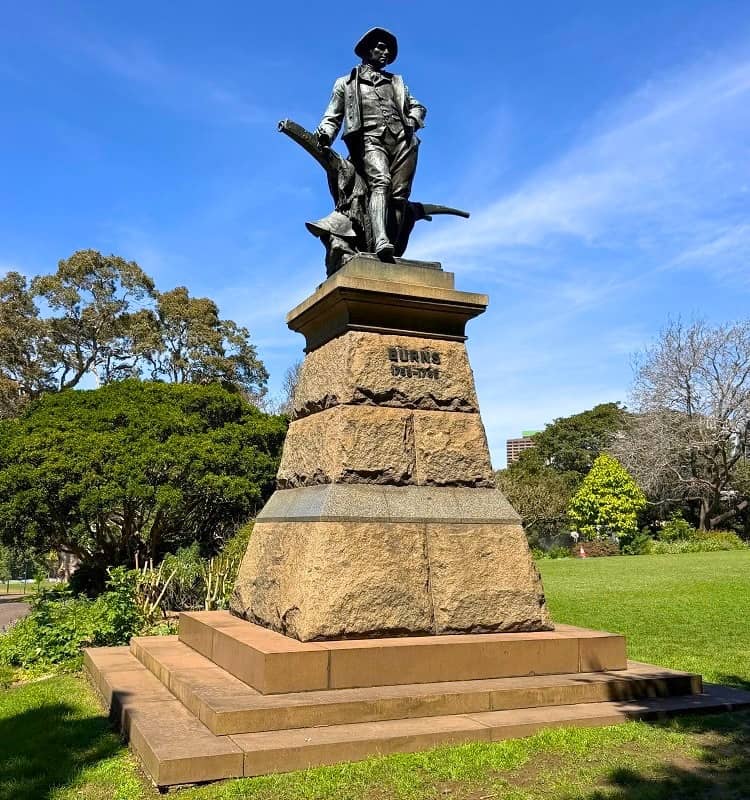
This bronze statue of Robert Burns stands along Art Gallery Road in The Domain, between the Art Gallery of New South Wales and St Mary’s Cathedral.
Burns (1759–1796) is widely regarded as the national poet of Scotland, and is known around the world for his songs and poems, including Auld Lang Syne, which is often sung on New Year’s Eve. The statue was made by British sculptor Frederick Pomeroy and cast in Surrey, and it was unveiled on 30 January 1905.
Standing about 3.2 metres tall including its plinth, it shows the poet leaning on a plough left standing in a furrow, wearing a Kilmarnock bonnet and the clothing of his day.
| Robert Burns | |
|---|---|
| Sculptor: | Frederick William Pomeroy |
| Year unveiled: | 1905 |
| Location: | The Domain (Art Gallery Road) |
8. John Robertson
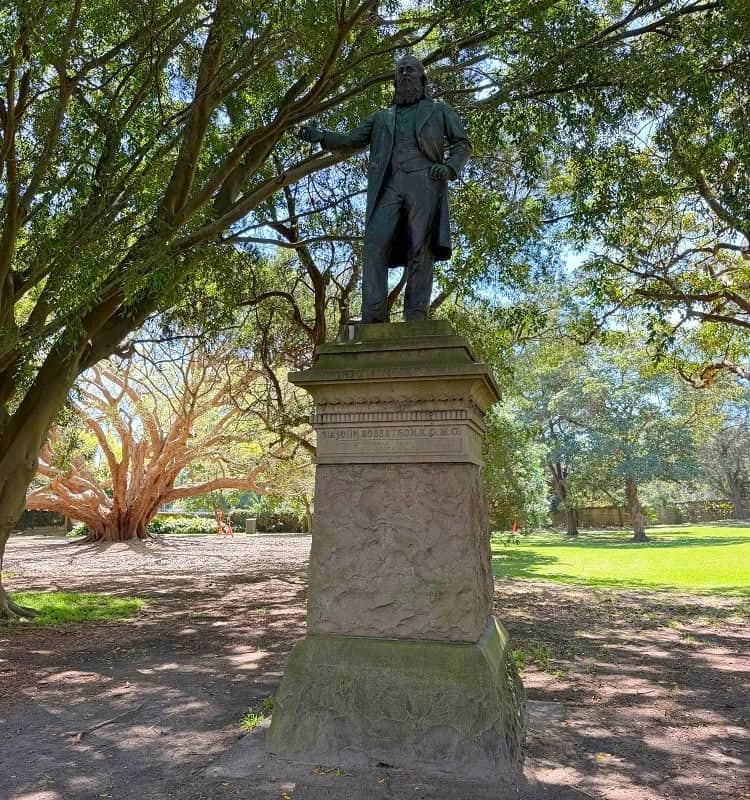
This life-sized bronze statue of Sir John Robertson is tucked away under a row of trees in The Domain, near Art Gallery Road.
Robertson was a land reformer and politician who served as Premier of New South Wales four times between 1860 and 1886. As Lands Minister, he approved the opening of the Domain to pedestrians at night in 1860.
After his death in 1891, friends and admirers paid for the statue through public subscription, and his daughter unveiled it on 24 September 1904. It was designed by architect J. Horbury Hunt and made by James White at his Annandale studio.
| John Robertson | |
|---|---|
| Sculptor: | James White |
| Year unveiled: | 1904 |
| Location: | The Domain |
9. Henry Lawson
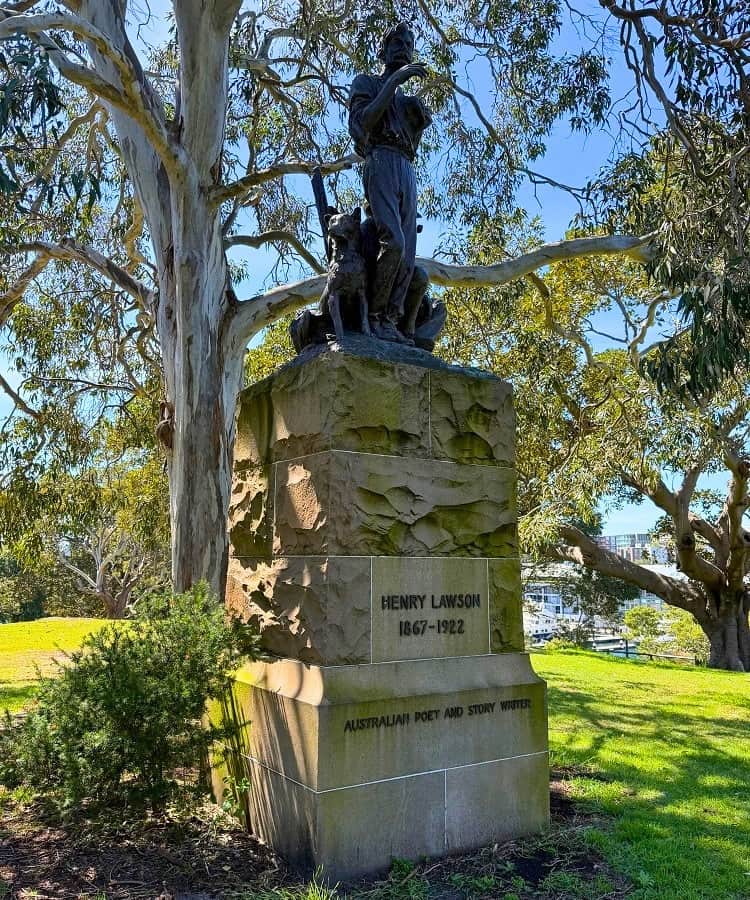
This bronze statue of Henry Lawson stands on a grassy knoll near the road to Mrs Macquarie’s Chair in the Royal Botanic Garden.
Lawson (1867–1922) was a poet and short story writer, often called Australia’s greatest short-story writer, and the statue shows him with a swagman and a sheepdog. It was commissioned by the Henry Lawson Memorial Fund committee five years after his death, and it was the last work of sculptor George Washington Lambert.
Governor Sir Philip Game unveiled it on 28 July 1931, and at the time it was thought to be the first statue of an Australian poet erected in the country.
| Henry Lawson | |
|---|---|
| Sculptor: | George Washington Lambert |
| Year unveiled: | 1931 |
| Location: | Royal Botanic Garden (Mrs Macquaries Road) |
10. King Edward VII
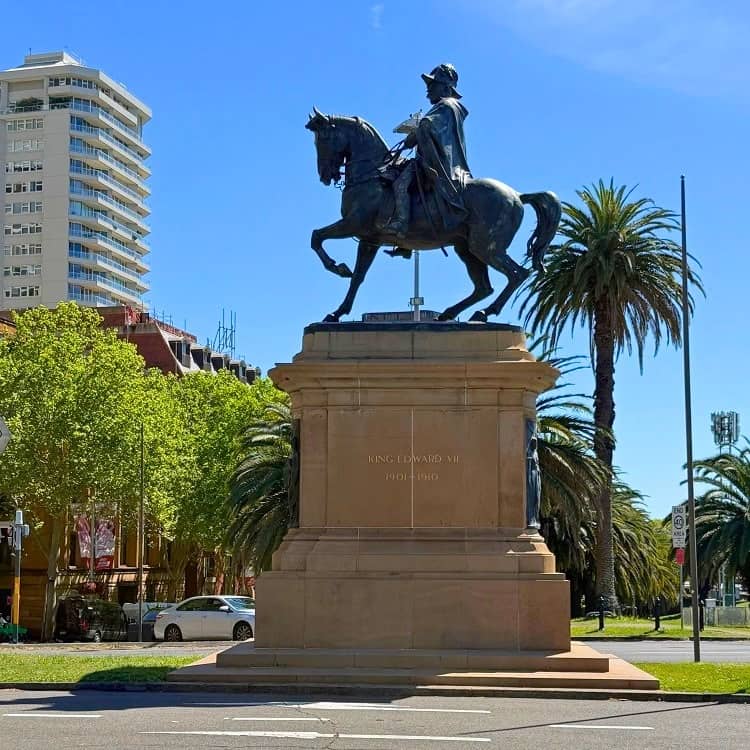
This bronze equestrian statue of King Edward VII stands on the corner of Macquarie and Bridge streets, opposite the Sydney Conservatorium of Music.
Edward was Queen Victoria’s eldest son, and he reigned from 1901 until his death in 1910. About a year later, the Sydney Chamber of Commerce and the Highland Society of New South Wales started a memorial fund, and the plan was to place the statue at the entrance to Hyde Park. The outbreak of World War I stopped the statue from being cast, and after the war the project went ahead on a smaller scale.
The statue, by British sculptor Sir Thomas Brock, arrived in Sydney before a site had been secured. It was unveiled on Empire Day, 24 May 1922, and relief panels on its plinth represent empire and unity, and peace and progress.
| King Edward VII | |
|---|---|
| Sculptor: | Sir Thomas Brock |
| Year unveiled: | 1922 |
| Location: | Corner of Macquarie and Bridge Streets |
11. Captain Arthur Phillip
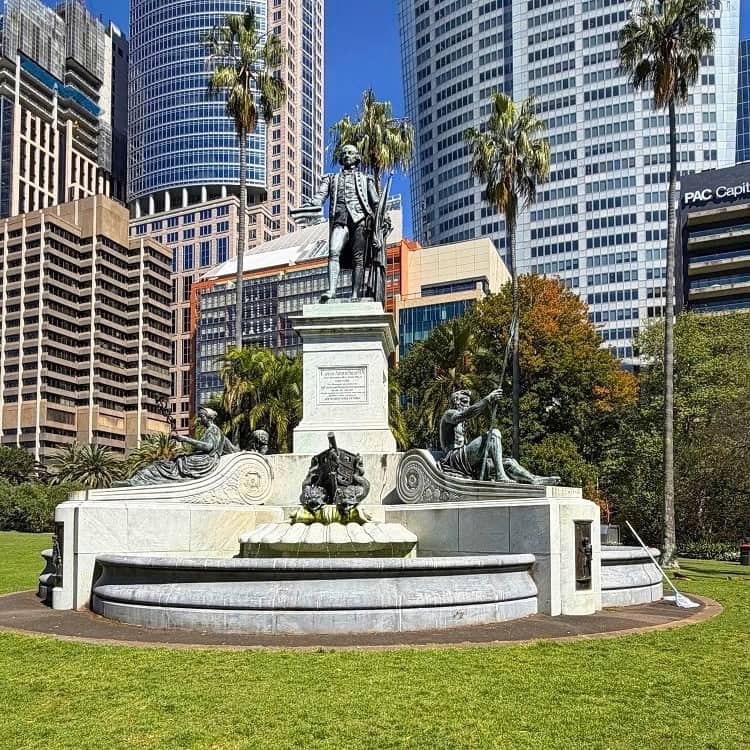
This statue of Captain Arthur Phillip, the first Governor of New South Wales, stands at the top of the Governor Phillip Fountain in the Royal Botanic Garden. Phillip led the First Fleet and, in January 1788, chose Port Jackson as the site for the new settlement.
The fountain was designed by Achille Simonetti and commissioned by Sir Henry Parkes as part of the 1888 Centennial celebrations. It was unveiled on 22 June 1897 by the then Governor, Lord Hampden, during celebrations for Queen Victoria’s Diamond Jubilee.
Made from four types of marble, the fountain features 13 bronze elements, including four reclining figures and four panels depicting Aboriginal hunting techniques. It stands on the site of the former Garden Palace and was conserved in 2020.
| Captain Arthur Phillip | |
|---|---|
| Sculptor: | Achille Simonetti |
| Year unveiled: | 1897 |
| Location: | Royal Botanic Garden (Macquarie Street) |
12. Sir Richard Bourke
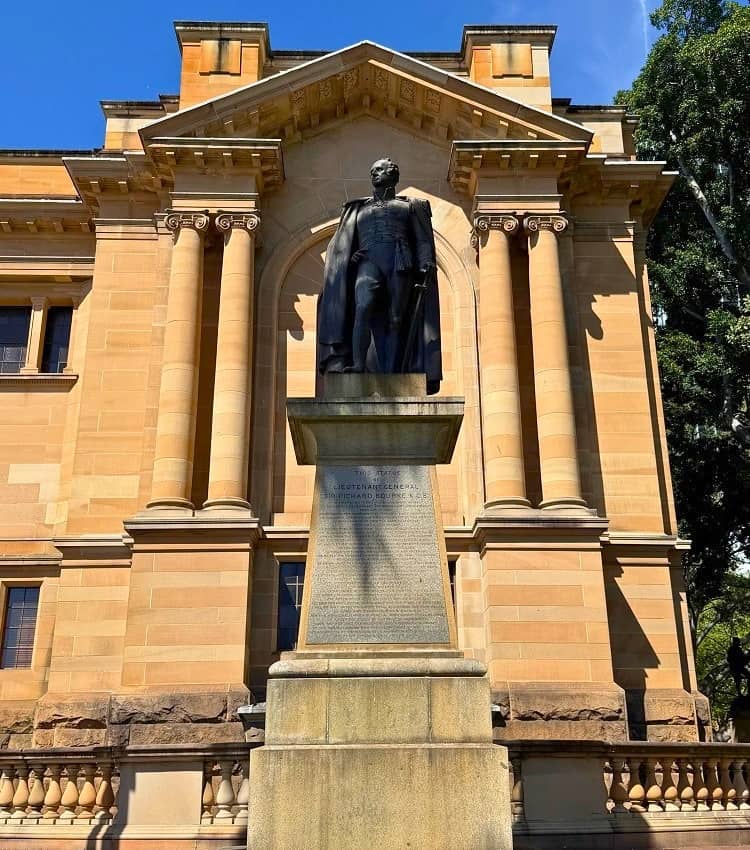
Standing outside the State Library of NSW facing Shakespeare Place, this bronze statue of Sir Richard Bourke is Australia’s first public sculpture.
Bourke was Governor of New South Wales from 1831 to 1837 and is regarded as one of the colony’s most popular early governors, in part for reforms such as extending trial by jury. A public subscription for a statue was proposed before he had even left Sydney.
As the colony couldn’t cast bronze, Bourke’s son commissioned London sculptor Edward Hodges Baily to make it in 1838. Governor Gipps unveiled the statue on 11 April 1842, in front of huge crowds on a public holiday. It originally stood at the Bent Street entrance to the Domain and was moved to its current spot in 1925.
| Sir Richard Bourke | |
|---|---|
| Sculptor: | Edward Hodges Baily |
| Year unveiled: | 1842 |
| Location: | State Library of NSW |
13. Matthew Flinders
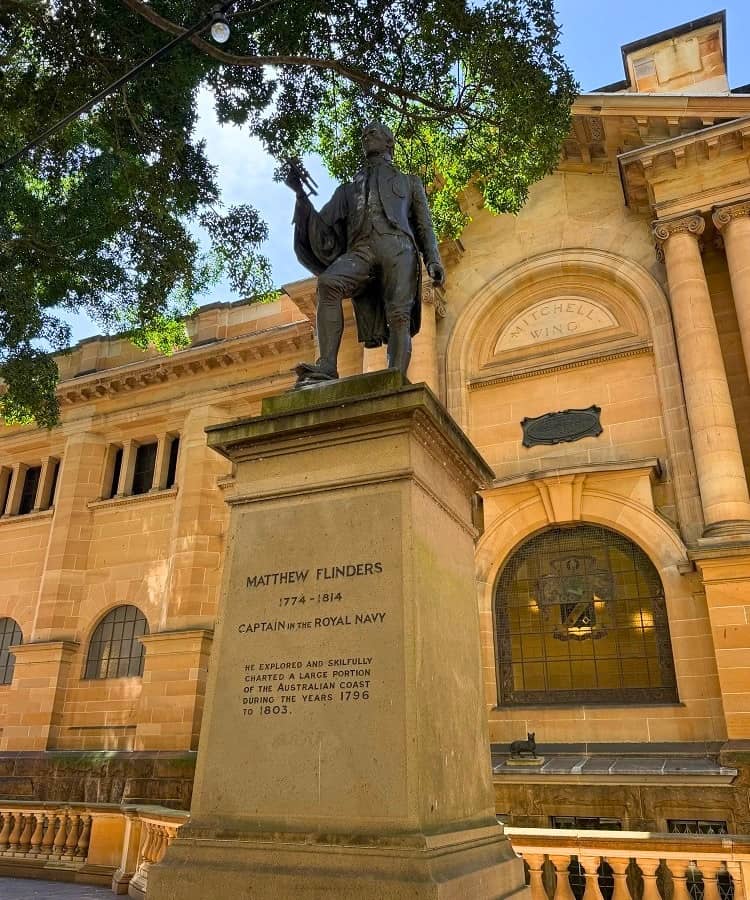
This bronze statue of Matthew Flinders stands on Macquarie Street, outside the State Library of NSW.
Flinders was a Royal Navy captain who, in 1798, sailed from Sydney in the sloop Norfolk and circumnavigated what is now Tasmania, proving it was an island. Between 1801 and 1803, he sailed around the Australian mainland in HMS Investigator, charting much of the coast. He later spent six and a half years as a prisoner of war on Mauritius and died in 1814.
The statue, by sculptor William Robert Colton, was unveiled in 1925 after Flinders’ grandson, Sir Flinders Petrie, offered the explorer’s papers to the first state to erect a statue in his honour. Sydney won, and the papers are now held in the Mitchell Library, part of the State Library.
| Matthew Flinders | |
|---|---|
| Sculptor: | William Robert Colton |
| Year unveiled: | 1925 |
| Location: | State Library of NSW |
14. James Martin
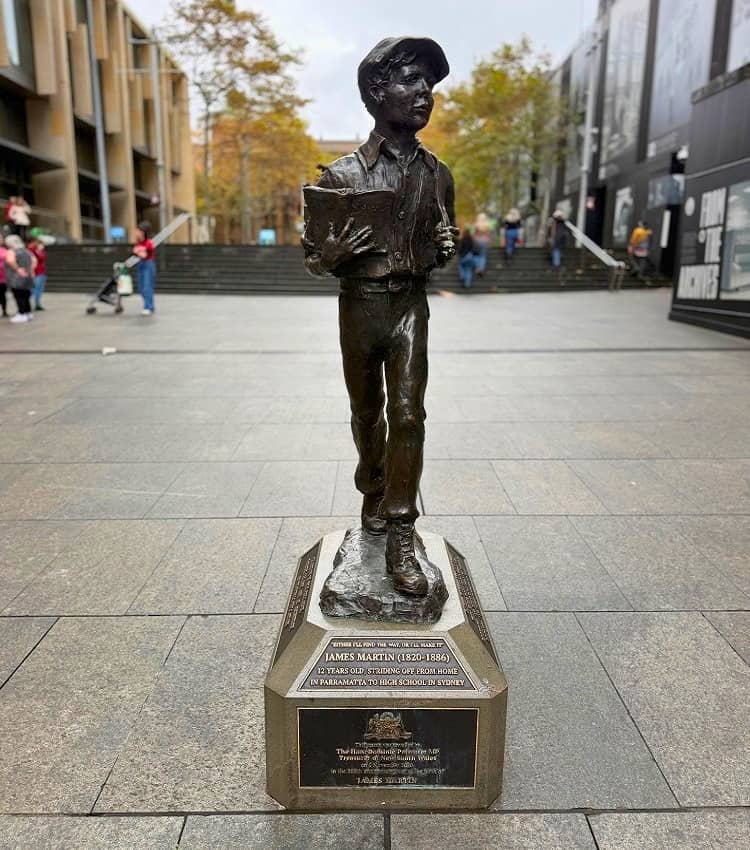
This bronze statue in Martin Place honours Sir James Martin, the man the plaza is named after.
Martin grew up in Parramatta, the son of a horse groom, and went on to become Premier of New South Wales three times, as well as Attorney-General and Chief Justice, the only person to have held all three roles. Sir Henry Parkes named Martin Place after him, but the first memorial here was a small plaque, added in 1977.
The statue, by sculptor Alan Somerville, was unveiled in November 2020. Rather than an older statesman, it shows Martin as a boy striding forward with books in his hands, a nod to his long trips to school from Parramatta. A matching statue stands in Parramatta.
| James Martin | |
|---|---|
| Sculptor: | Alan Somerville |
| Year unveiled: | 2020 |
| Location: | Martin Place |
15. John Dunmore Lang
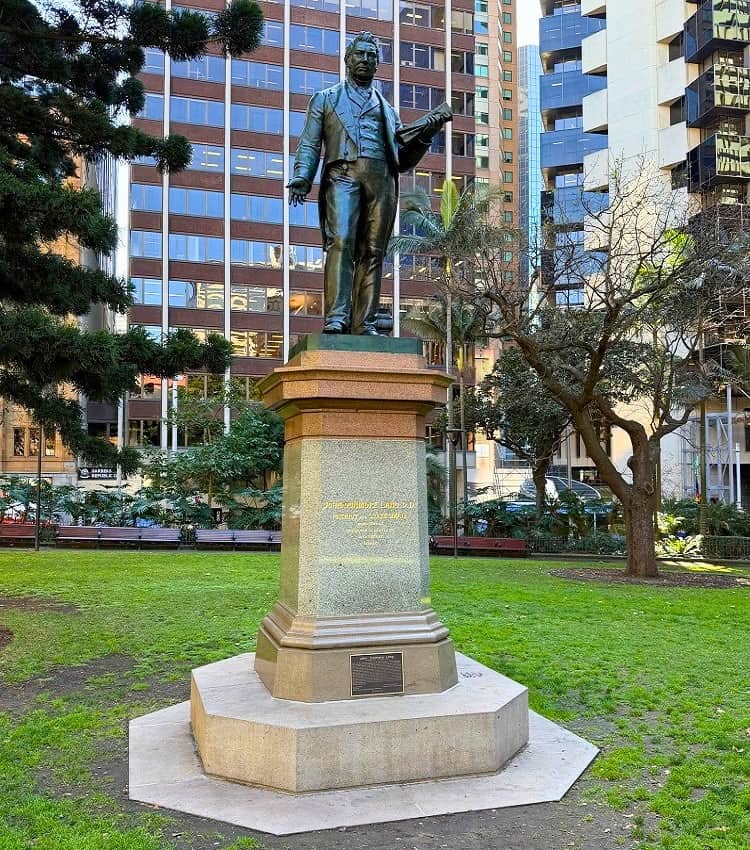
This larger-than-life bronze statue of John Dunmore Lang stands in Wynyard Park, where he once addressed the public in support of popular causes.
Lang (1799–1878) was a Scottish-born Presbyterian minister who founded the Presbyterian Church in Australia and served as minister of Scots Church for 55 years. He was also a politician and a vocal republican, and he campaigned for Victoria and Queensland to become separate colonies.
The statue was made by London sculptor Giovanni Fontana and unveiled on 26 January 1891 by Lang’s wife, in front of several thousand people, including the Governor and Premier Sir Henry Parkes. Sir John Robertson, one of the early backers of the memorial, was also there.
| John Dunmore Lang | |
|---|---|
| Sculptor: | Giovanni Fontana |
| Year unveiled: | 1891 |
| Location: | Wynyard Park |
16. Thomas Sutcliffe Mort
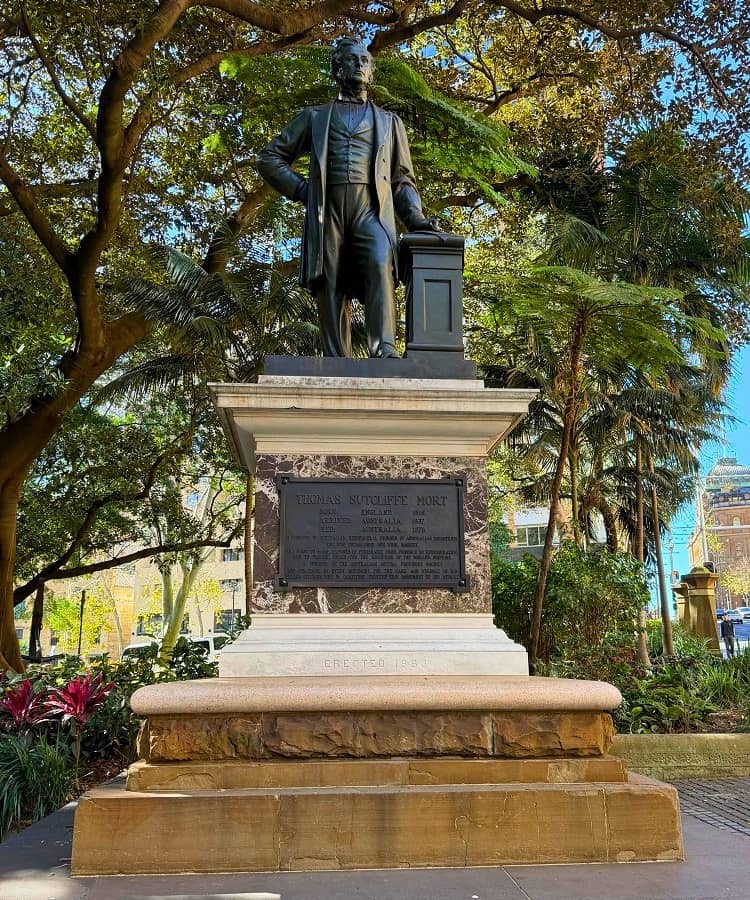
Erected in 1883 and sculpted by Pierce Francis Connelly, the Thomas Sutcliffe Mort statue commemorates a pioneer of Australian resources and industries.
Mort (1816–1878) arrived in Australia in 1838 and, through a string of commercial ventures and pastoral enterprises, rose to become one of Sydney’s leading businessmen. He had made his fortune by the end of the 1840s.
His bronze statue stands in the south-western corner of Macquarie Place Park on Bridge Street, on the site of one of Sydney’s first fountains. Unveiled by Governor Lord Augustus Loftus on Saturday 9 June 1883, it faces the Royal Exchange, which was then the largest wool-selling centre in the world.
| Thomas Sutcliffe Mort | |
|---|---|
| Sculptor: | Pierce Francis Connelly |
| Year unveiled: | 1883 |
| Location: | Macquarie Place Park |
17. Governor William Bligh
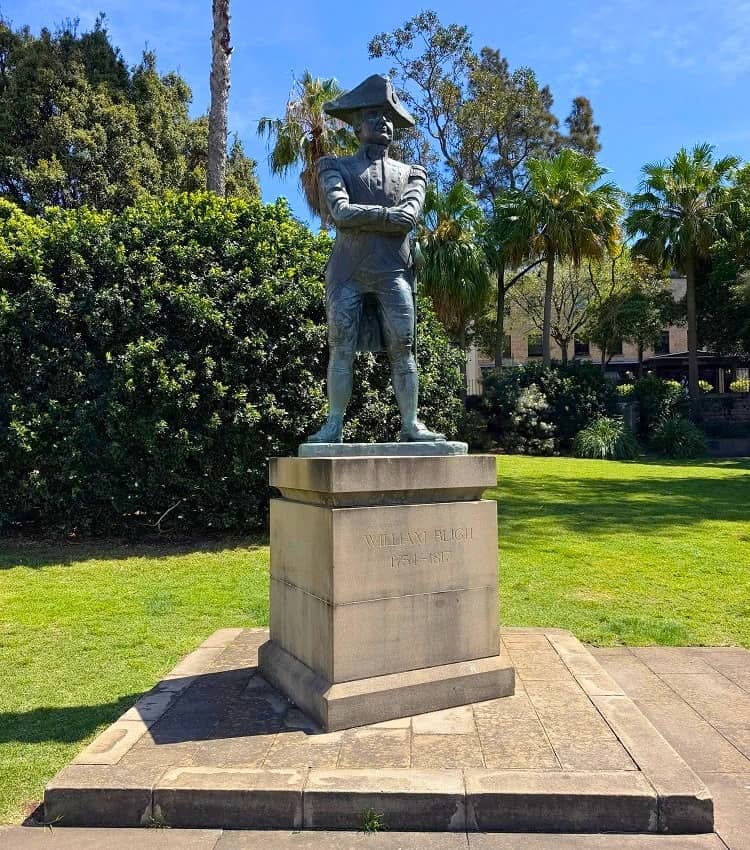
This bronze statue of William Bligh stands at 112 George Street in The Rocks, next to Cadman’s Cottage, looking out over Sydney Harbour. Sculpted by Marc Clark, it shows Bligh in full uniform, with a sword and his arms folded, and was unveiled on 18 December 1987.
Bligh is best known for the 1789 mutiny on HMS Bounty, after which he navigated an open boat about seven metres long to Timor with 18 companions. He was Governor of New South Wales from 1806 and was deposed in the Rum Rebellion, when the New South Wales Corps arrested him on 26 January 1808.
The inscription on the back argues that legends have unfairly damaged his reputation, and says the statue aims to restore his image.
| Governor William Bligh | |
|---|---|
| Sculptor: | Marc Clark |
| Year unveiled: | 1987 |
| Location: | The Rocks (112 George Street) |


